


Identity as an Anchor: Nataliia Kryvda on Helping Children Hold On to Their Sense of Self
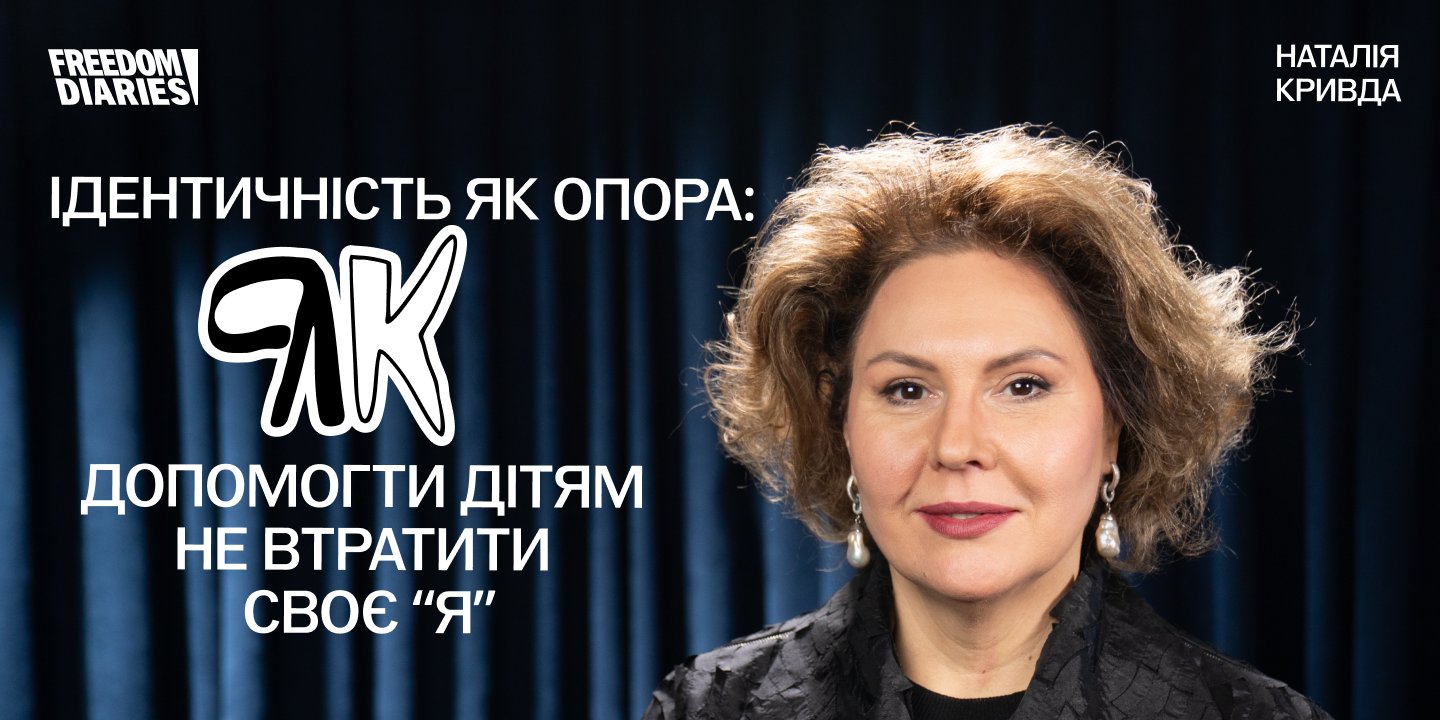
“Who am I?” — a simple question that Ukrainian children today are often forced to answer either in bomb shelters or in unfamiliar classrooms abroad. In times of chaos and war, national identity becomes more than a term from a textbook. It becomes an inner compass, a shelter for values, and a source of pride.
The Freedom Diaries team spoke with Nataliia Kryvda — Doctor of Philosophy, Professor at Taras Shevchenko National University of Kyiv, and Chair of the Supervisory Board of the Ukrainian Cultural Foundation. Together, we explored how Ukrainian identity is formed in children, why culture can become a bridge back home, and how to nurture inner freedom in teenagers when their physical world is shaped by air raid sirens or forced relocation.
IDENTITY IS NOT ONLY ABOUT ORIGINS — IT IS ABOUT SHARED VALUES
— Nataliia, many people think identity is something abstract and theoretical. But looking at what children write and draw in Freedom Diaries, it feels like a very alive and intuitive answer to the question: “Who am I and where are my roots?” Why is holding onto these things so important now?
— When we speak about identity, we should understand one key idea: Ukrainian national identity is the identity of a political nation. It is formed at the intersection of two important dimensions.
On one hand, ethnic foundations matter: culture, language, and traditions of Ukrainians, Crimean Tatars, Jewish communities, Gagauz people, and many others who have lived on the territory of Ukraine for centuries.
On the other hand — and this is equally important — civic identity is built through shared values: freedom, dignity, solidarity, equality, the rule of law, and justice. These fundamental principles create the philosophical framework of being a citizen — both inside the country and beyond its borders.
Does this sound too complex for a child or teenager? Not at all.
Children often grasp identity more sharply than adults — through relationships, observation, and intuition. They deeply need an answer to the question: “Who am I?” That answer becomes their internal compass.
“Today, identity may be one of the defining forms of political belonging in times of war. If this is an existential struggle between tyranny and democracy, authoritarianism and free choice, then identity becomes a refuge for the values of dignity and freedom.”
This perspective matters in conversations with children.
And one of the simplest ways to begin is through understanding our own history — not only through stories of loss and tragedy, but also through achievements, victories, and Ukraine’s place within the European cultural space.
Every young person should know: we have something to be proud of.
EDUCATION AND A ONE VOICE POLICY: HOW TO HELP YOUNG PEOPLE NOT DISSOLVE ABROAD
— We see children in Saturday and Sunday schools abroad reconnecting with home through creative practices. Can culture and informal education become the bridge that helps preserve their Ukrainian sense of self?
— School and education, in general, are among the strongest forces in shaping and sustaining national identity.
Researchers who study successful identity-building strategies repeatedly emphasize that strong, forward-looking national education remains one of the most effective tools.
I would speak about the importance of building a One Voice Policy in education — from preschool to university, including non-formal educational spaces.
Sunday schools, clubs, lectures, and community spaces abroad become places where children begin to experience belonging naturally — through participation rather than pressure.
We should also remain realistic.
As difficult as it may be to admit, not every child will return to Ukraine or remain within Ukrainian citizenship. But even abroad, children can remain carriers and ambassadors of their culture.
In academic discourse, there is a concept known as cut and mixed identity.
The world is moving toward more plural and layered forms of belonging.
Living across countries and cultures should not erase Ukrainianness — on the contrary, it can strengthen a person, making them more adaptable and more capable of navigating a global world.
INNER FREEDOM AS A SKILL FOR THE FUTURE
— In Freedom Diaries, we talk with children about freedom not only as borders on a map, but also as freedom to think, feel, and dream. Why is it so important to cultivate inner freedom now, when children’s physical reality is constrained by war?
— Freedom appears across the entire system of European values and is one of the deepest archetypes of Ukrainian culture.
Our language itself reflects this richness by distinguishing different dimensions of freedom.
Why is it important for children to understand both the possibility and the limits of freedom?
Because modern life requires us to coexist in different contexts.
Freedom is not limitless permission.
It is also the ability to respect the boundaries of others, to accept difference, to live together, and to protect your own space.
Today, during war, children often clearly understand who is “their own” and who is “the other.”
But after our inevitable victory, we will face a serious challenge.
Either we allow different wartime experiences to divide Ukrainian society — those who stayed, those who left, those who fought — or we learn to hold those experiences together.
Inner freedom and the ability to think beyond rigid categories are exactly the skills that will help children build unity instead of division.
CULTURE CANNOT BE NEUTRAL
Identity is not static — it is dynamic.
It cannot simply be preserved unchanged.
It must be continuously discussed, reflected on, and integrated into contemporary artistic and educational practices.
Creativity during wartime carries responsibility.
Art should never become propaganda.
But it also cannot pretend to be neutral.
The dangerous idea that “art exists outside politics” risks normalizing violence.
Attempts to create false moral symmetry between aggressor and victim are unacceptable.
This is why projects like Freedom Diaries matter today.
They help children safely unpack difficult ideas, reconnect with their culture through creativity, and build an inner foundation that no one can take away.
Prepared by the Freedom Diaries communications team
Photo: Nataliia Kryvda press office